

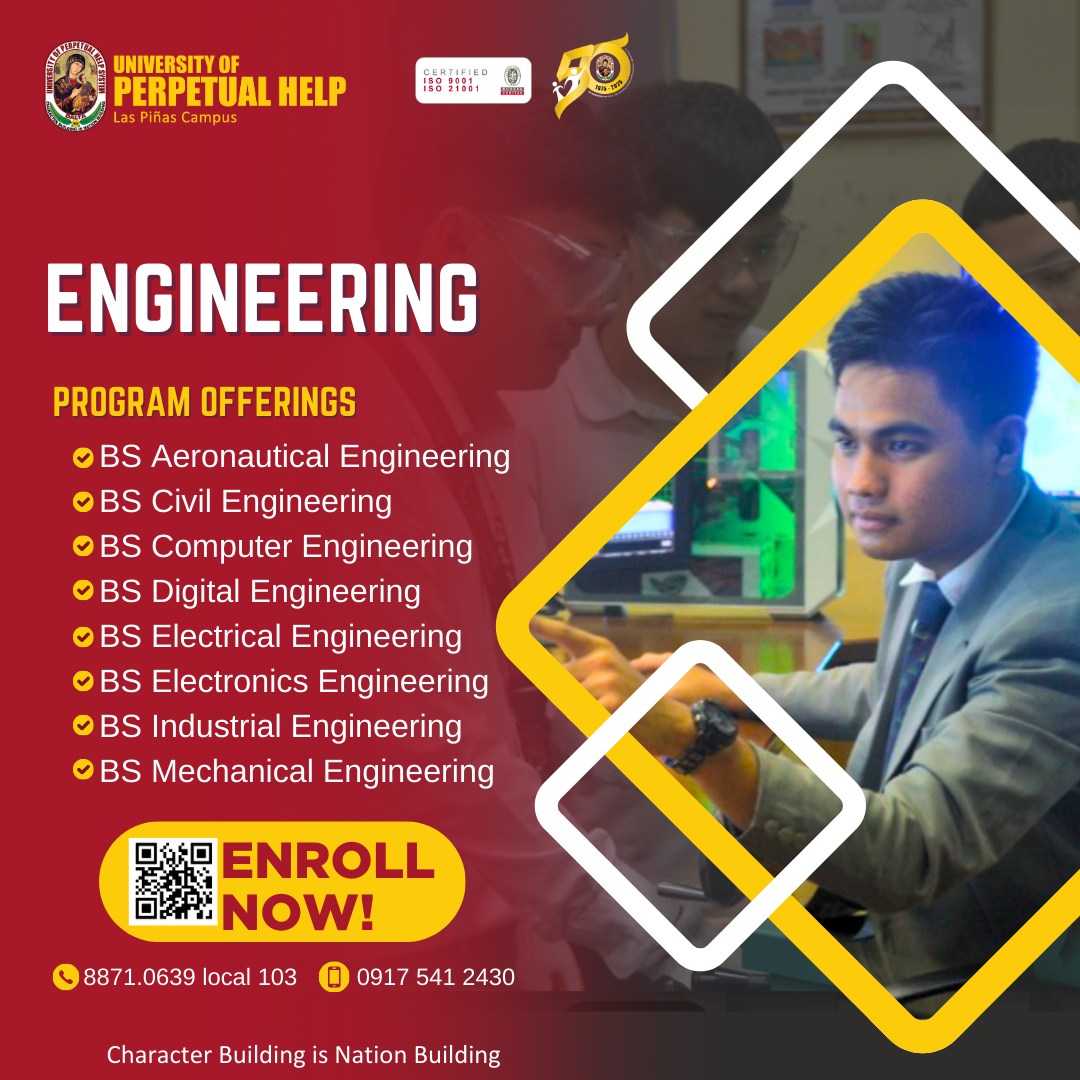
Bachelor of Science in Industrial Engineering (BSIE) — UPHSD Las Piñas

A systems-oriented engineering program that prepares students to design, improve, and optimize integrated systems of people, materials, information, equipment, and energy.

Engineer smarter solutions with a Bachelor of Science in Industrial Engineering (BSIE)—a CHED-recognized program that prepares students to design, improve, and manage complex systems in manufacturing, logistics, and service industries. This course blends engineering principles with business strategy to develop future-ready industrial engineers in the Philippines.

Program overview

The Bachelor of Science in Industrial Engineering (BSIE) at UPHSD Las Piñas Campus focuses on developing analytical, technical, and managerial skills needed to improve productivity, efficiency, and quality in organizations. The program integrates engineering principles with business, data analysis, and decision-making tools to prepare graduates for leadership roles in manufacturing, service, and technology-driven industries.

Why choose UPHSD Las Piñas for Industrial Engineering?

  • Specialized training in operations research, systems engineering, supply chain management, and quality control
  • Hands-on experience with simulation software, process mapping, and lean manufacturing tools
  • Internship opportunities with factories, logistics firms, consulting agencies, and corporate operations teams
  • Prepares students for careers in production planning, process improvement, project management, and data-driven decision-making
  • Ideal for students passionate about efficiency, problem-solving, and systems optimization

Program highlights

  • Operations research and systems optimization.
  • Production planning, quality management, and supply chain systems.
  • Human factors engineering and ergonomics.
  • Engineering economics and project management.
  • Capstone projects addressing real organizational challenges.

Curriculum snapshot

  • Year 1: Engineering Mathematics, Basic Sciences, Introduction to IE
  • Year 2: Probability & Statistics, Engineering Economy, Work Study
  • Year 3: Operations Research, Quality Engineering, Facilities Planning
  • Year 4: Systems Design, Internship, Capstone Project

Career Opportunities

Graduates can pursue roles such as:

  • Industrial Engineer
  • Operations or Process Improvement Analyst
  • Quality Assurance Engineer
  • Supply Chain or Logistics Analyst
  • Project Manager
  • Management or Systems Analyst
  • Entrepreneur or Business Consultant
  • Business Analyst
    Consultant
  • Data Analyst
  • Health Care System Engineer
  • Industrial Engineer
  • Lean Manufacturing Specialist
  • Logistics Coordinator
  • Management System Engineer
  • Manufacturing Engineer
  • Methods Engineer
  • Operations Manager
  • Operations Research Analyst
  • Planning Engineer
  • Process Engineer
  • Process Improvement Specialist
  • Product Manager
  • Project Engineer / Manager
  • Project Manager
  • Quality Assurance Engineer
  • Risk Management Analyst
  • Sustainability Consultant

Accreditation & Quality Assurance

UPHSD follows institutional quality assurance processes and national regulations for engineering programs. The BSECE curriculum is designed to meet professional standards and to prepare students for the Board Exam for Electrical Engineers. For the latest accreditation status and program approvals, contact the campus registrar or the Admissions Office.

Apply & Contact

Interested in shaping your future career? Apply to one of the programs at the Las Piñas Campus of the University of Perpetual Help System DALTA or schedule a campus visit to explore the opportunities waiting for you.

Campus Address:
Alabang–Zapote Road, Pamplona 3, Las Piñas City, 1740

Phone:
(02) 8871-0639 local 103 | 0917-541-2430

Email:
information@perpetualdalta.edu.ph

Admission Requirements

  • SF 9 (Original Report Card)
  • Certificate of Good Moral Character
  • Photocopy of Birth Certificate (PSA Issued)
  • Latest 2×2 picture (3pcs.)
  • Ishihara and Audiometry Test Result for Maritime Education
  • Ishihara Medical Test Result for Doctor of Dental Medicine and Aviation Electronic Technology
  • 1 Long Brown Envelope
  • 1 Long White Folder

BS INDUSTRIAL ENGINEERING PROGRAM

Program Educational Objectives

The Program Educational Objectives of the Industrial Engineering Program of the College of Engineering of the University of Perpetual Help System DALTA represent the expected characteristics and/or accomplishments of our Industrial Engineering graduates. Within three to five years after obtaining the degree, our graduates:

  1. demonstrate high level technical competence in industrial engineering or in any specialized or related field of industrial engineering;
  2. exhibit growing professional career in industrial engineering practice and research; and
  3. pursue industrial engineering and technical activities relevant to the needs of the industry and the community.

Student Outcomes

Upon completion of the BS in Industrial Engineering Program, graduates should have acquired the following knowledge, skills, competencies and attitude:

  1. Apply knowledge of mathematics, natural science, engineering fundamentals, and an engineering specialization to the solution of complex engineering problems.
  2. Conduct investigations of complex engineering problems using research-based knowledge and research methods including design of experiments, analysis and interpretation of data, and synthesis of information to provide valid conclusions.
  3. Design solutions for complex engineering problems and design systems, components or processes that meet specified needs with appropriate consideration for public health and safety, cultural, societal, and environmental considerations.
  4. Function effectively as an individual, and as a member or leader in diverse teams and in multi-disciplinary settings.
  5. Identify, formulate, research literature and analyze complex engineering problems reaching substantiated conclusions using first principles of mathematics, natural sciences and engineering sciences.
  6. Apply ethical principles and commit to professional ethics and responsibilities and norms of engineering practice.
  7. Communicate effectively on complex engineering activities with the engineering community and with society at large, such as being able to comprehend and write effective reports and design documentation, make effective presentations, and give and receive clear instructions.
  8. Understand and evaluate the sustainability and impact of professional engineering work in the solution of complex engineering problems in societal and environmental context.
  9. Recognize the need for, and have the preparation and ability to engage in independent and life-long learning in the broadest context of technological change.
  10. Apply reasoning informed by contextual knowledge to assess societal, health, safety, legal and cultural issues and the consequent responsibilities relevant to professional engineering practice and solutions to complex engineering problems.
  11. Create, select and apply appropriate techniques, resources, and modern engineering and IT tools, including prediction and modelling, to complex engineering problems with an understanding of the limitations.
  12. Demonstrate knowledge and understanding of engineering management principles and economic decision-making and apply these to one’s own work, as a member and leader in a team, to manage projects and in multidisciplinary environments.
  13. Ability to design, develop, implement, and improve integrated systems that include people, materials, information, equipment and energy

Learning Approach & Industry Projects

  • Problem-based and outcomes-based learning approaches.
  • Case studies on real-world industrial and service systems.
  • Simulation, modeling, and data-driven decision-making projects.
  • Capstone projects focused on productivity, efficiency, and quality improvement.

Internships & Employer Connections

Students complete supervised industry internships with partner manufacturing firms, logistics companies, service organizations, and technology-driven enterprises. These partnerships provide practical experience, professional mentorship, and strong employment prospects after graduation.

Frequently asked questions (FAQs)

How long is the BSIE program?

The program typically takes five (5) years, including required internship.

Yes. Industry internship is a core requirement of the program.

Yes. The program integrates engineering and management principles.

UPHSD Las Piñas Campus offers academic scholarships and financial assistance.

Manufacturing, logistics, healthcare, IT, banking, consulting, and service industries.

Visit or Contact us

Get in Touch

For detailed program inquiries, faculty list, tuition rates, or to schedule a campus tour, contact the Las Piñas admissions office.